


Colourful box houses as far as the eye can see. The Gamcheon Culture Village in Busan, also called the Machu Picchu of Busan by some, sits right at the top of every must-see list. And that is exactly where the problem starts. In 2024 around 2.87 million visitors came. What awaits you up there doesn’t have much in common any more with the photo that lured you here. The visit is still worth it. Just in a completely different way than most people plan it.
Getting to Gamcheon Culture Village
The standard route: bus from Toseong Station
Most people take metro line 1 to Toseong Station and change there to one of the small village buses up to the Gamjeong Elementary School stop. From there it’s another five minutes on foot. Sounds straightforward, BUT! At peak times these buses are completely packed. You queue up and may not even make it onto the overcrowded bus. And if you do get on, the near-death experience begins. At what feels like 200 km/h the little village bus races up and down the narrow hairpin bends on two wheels.
Taxi
A taxi from Toseong costs about 5,000 Won. In practice it isn’t always faster either, because the access road is often jammed. But it is far more relaxed than the bus.
My tip: walk
I made a virtue out of necessity and simply walked. And why that is the best option of all is further down in the insider tips.
Background and culture of Gamcheon Culture Village
The settlement came into being in the 1920s and 1930s for working-class families from Busan. The decisive boost came in 1955 with the arrival of around 800 families belonging to the religious community Taegeukdo. The houses were set into the slope in terraces, in strict rows, none of them blocking the view of another. That rule is the reason for the staircase look you see in every photo today. It wasn’t a design idea, but consideration among poor neighbours.
The district stayed poor for a long time. Only in 2009 did an art project start to revive it as a culture village. Artists moved in, murals and museums appeared. The plan worked: visitor numbers rose from 1.4 million in 2015 to 2.87 million in 2024. At the same time many residents moved away, and hundreds of houses turned into galleries and cafés. That’s the thing to keep in the back of your mind: people live here. The colourful façades aren’t a stage set, they are front gardens.
Hidden gem or scam?
I asked myself that question too before heading into the village. Is it really worth it, or should you rather skip Gamcheon Culture Village?
What awaits you in Gamcheon Culture Village
Honestly: the central lanes are completely overrun. You shuffle along in a crowd through narrow paths where somebody is constantly stopping to take a photo. On every corner a designated photo spot, a queue in front of it, and next to it an Insta café with a view terrace or a souvenir shop.
The Little Prince on the wall has a queue of his own. So does the BTS mural. That’s where the fans line up for their picture. None of it has anything to do with the village, it was simply painted there because it works. All very over the top and optimised for social media. If you come here and only walk the main drag, you end up with the same five photos as everybody else and the feeling of having fallen for a marketing campaign.
The district has already been designated a special management area. From 6 p.m. tourists are meant to stick to five set routes only. Minibus access is being restricted and even an entrance fee is being considered. When a city treats its own flagship spot like that, it tells you something.
And yet: the beautiful corners
Now comes the big however. Precisely because the buses put me off, I walked, and on the way you pass through a part that the vast majority never see. The walking route takes you through Ami-dong, a neighbourhood with a history that gets under your skin.
From 1906 there was a Japanese cemetery here. When hundreds of thousands fled to Busan during the Korean War, they built their shelters on that very cemetery and used the tombstones and retaining walls as building material. To this day the inscribed stones sit in the steps and walls, which is why the area is called Bisagol, the tombstone village.
Nothing is painted in bright colours here and there are no queues. Instead there is laundry on the line, cats on the walls and people going about their daily lives. Every few minutes the view opens up and you find yourself at a lookout that gives you the slope, the sea of houses and the sea itself.
My verdict
The visit is worth it. But not because of the main lanes in the village, which are bursting at the seams. Because of everything around them.
Insider Tips
Walk up instead of taking the bus
This is my most important tip. Save yourself the crush in the village bus and use your own two feet. From Toseong Station up to the village it’s around 30 to 40 minutes, almost entirely over stairs and narrow lanes. It’s strenuous, no question. But this climb is worth it. You come through Ami-dong, you see the original Busan and along the way you get lookouts that no guidebook marks. If you don’t want to or can’t walk up, ride up and at least walk back down.
Carry on up the hillside
Inside the village itself the rule is: leave the main drag. Keep climbing the lanes until the souvenir shops stop. Up there on the slope you escape the bustle. From a small hiking path you get a wonderful view over the district with all the colourful houses in frame.
Come early or late
Between 11 a.m. and 4 p.m. the village is at its fullest, that’s when the tour buses unload. Early in the morning and in the late afternoon it gets noticeably quieter, and the light is better for photos anyway. Do mind the rules though: from 6 p.m. visitors are meant to stick to set routes.
Related posts
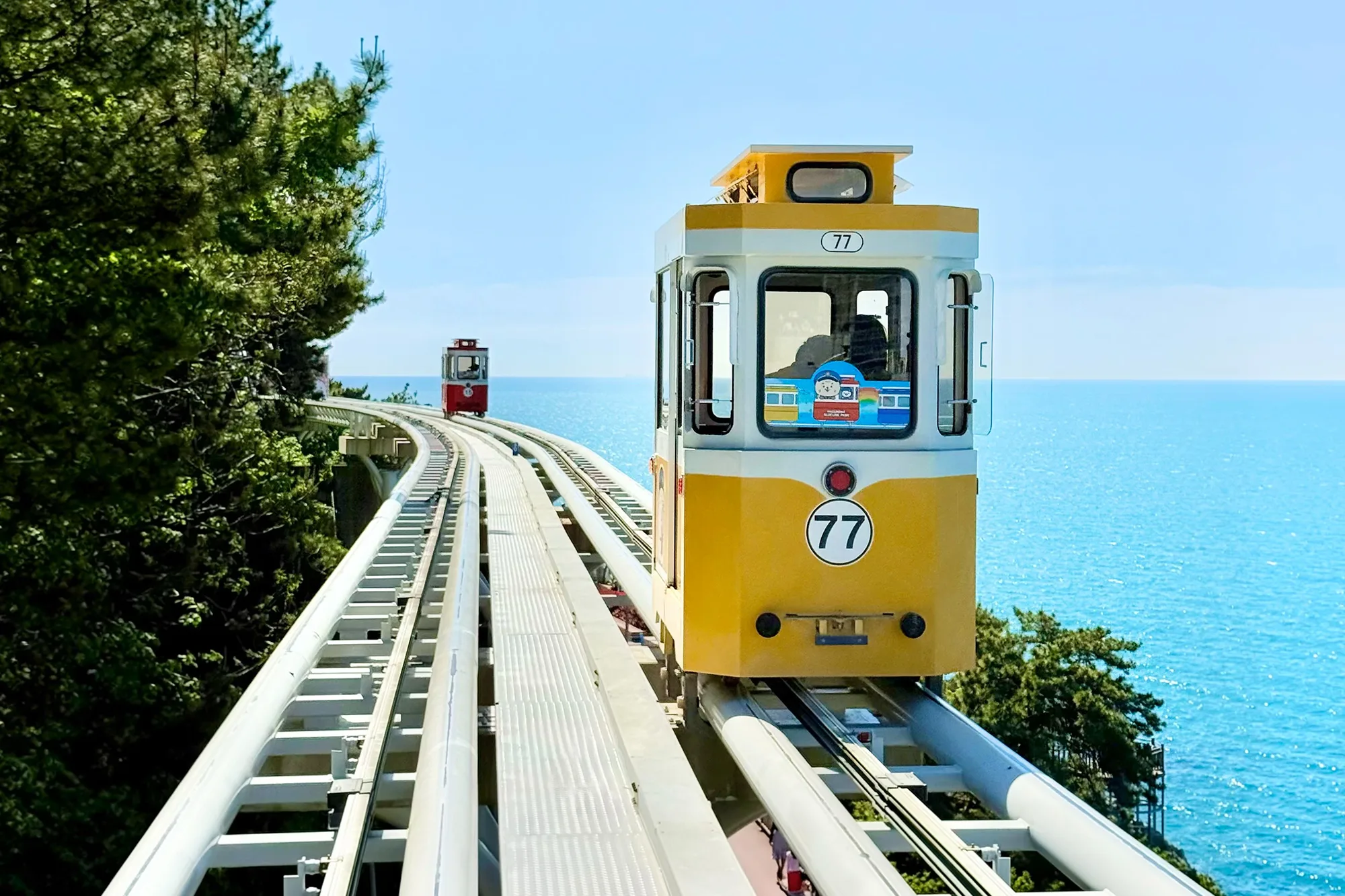
Sky Capsule Ride – Busan’s most beautiful train ride
Sky Capsule in Busan: which direction to book, how to get tickets, the difference to the Beach Train and my suggestion for the perfect day.

Top 5 Must See in Tokyo
The bustling metropolis of Tokyo combines historic temples and shrines with skyscrapers and futuristic technologies, creating a fascinating cultural diversity.

Top 5 sights in Barcelona
My top 5 for the tourist city of Barcelona, which is famous for its unique architecture, vibrant culture, and lively atmosphere.

Portable power bank on the go – ChargeSPOT
Out exploring the city and your phone battery dies. That's exactly what ChargeSPOT is here to fix – a really clever solution!
Questions, tips or notes?
Write a comment or send me an E-Mail…