


You have 2 to 3 weeks off and you want to travel to Japan? Then the big question comes up: where exactly? Here you get the Japan itinerary that fits, for two to three weeks, plus how much time each city really needs and which day trips are worth it. Everything about the best season by region, about entry and about preparing for your first trip to Japan is here: The first time in Japan
Why Honshū for your first trip?
Honshū 本州 is the largest of Japan’s four main islands. It offers scenic hiking trails in the Japanese Alps as well as the most important cities, Tokyo, Osaka, Kyoto and Hiroshima.
The perfectly built Shinkansen network lets you move quickly and comfortably between the regions of Honshū. For the roughly 500 kilometres from Tokyo to Kyoto you only need 2.5 hours, for example. That way you cover entire regions in just a few days.
The best approach is to do full day trips out of single cities. It saves you from constantly moving on with all your luggage.
Three routes for inspiration
Which Japan itinerary suits you in the end mostly comes down to your time budget. The opening is the same on all three routes: they take you from Tokyo via Kyoto to Osaka. Where you go after that is up to you and your schedule. Take them as inspiration and build your own dream route from them.
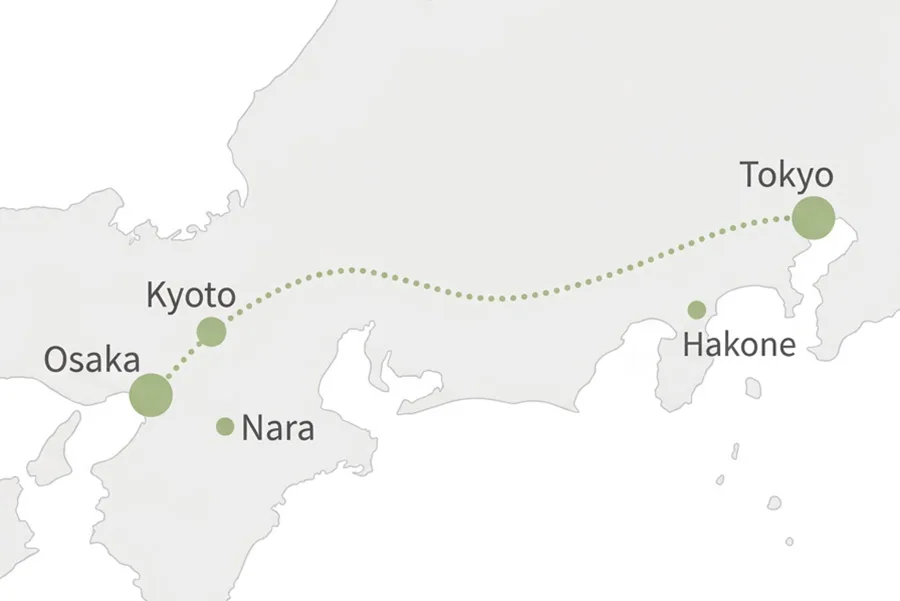
2 weeks, the standard route
Tokyo → Kyoto → Osaka → Tokyo
This is the simplest route and a perfect fit for a first trip to Japan. You only need four places to stay for three cities. Everything else you cover with day trips. For this route I would definitely not get a Japan Rail Pass. It does not pay off. Get a one way or round trip ticket for the stretch instead. All the details are here: Traveling through Japan with the Shinkansen
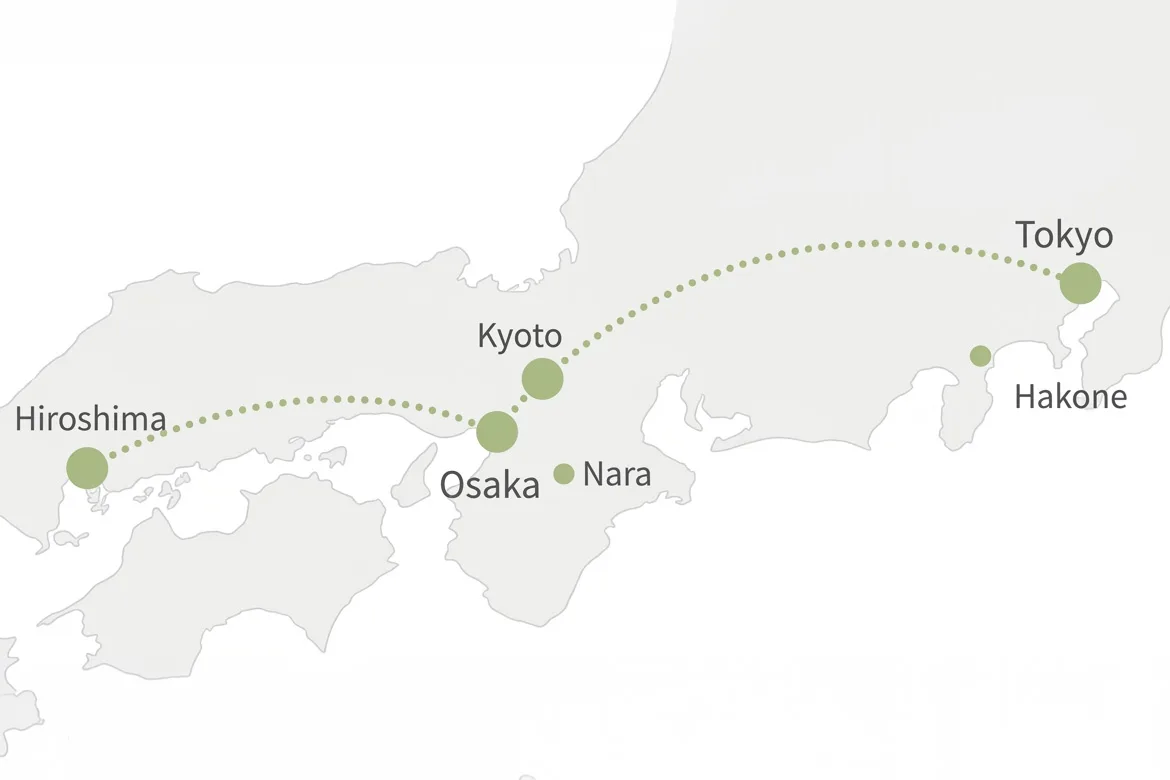
2.5 weeks with Hiroshima
Tokyo → Kyoto → Osaka → Hiroshima → Tokyo
The route is the same as the two week one, you just add Hiroshima after Osaka. And do not worry: on the map it looks like half a world tour, but it is not. The Shinkansen takes only 1.5 hours from Osaka to Hiroshima. The ride from Hiroshima straight back to Tokyo is quick too. Here as well the Japan Rail Pass does not pay off, so get single tickets instead.
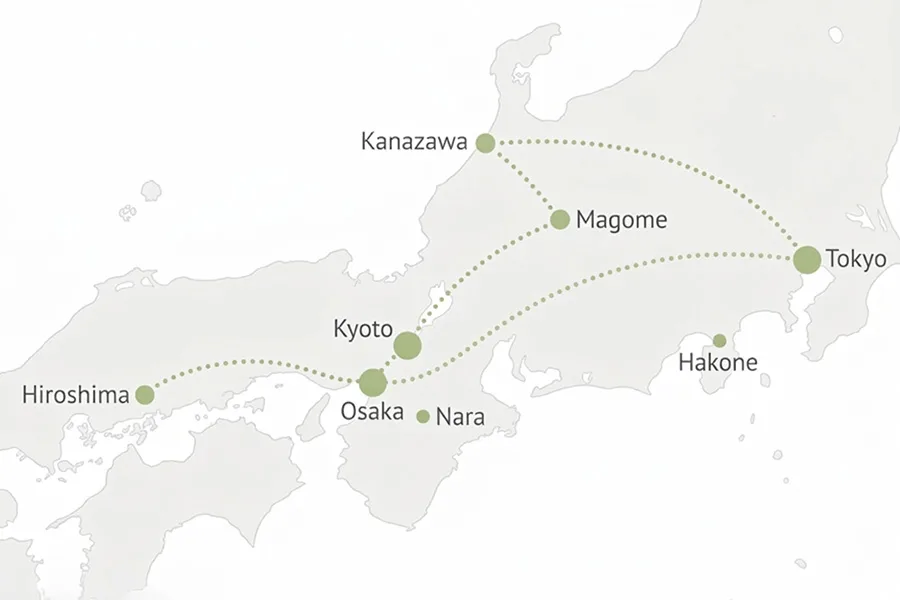
3 weeks round trip
Tokyo → Osaka → Hiroshima → Kyoto → Magome → Kanazawa → Tokyo
On top of Hiroshima you add a detour into the mountains to Magome. After that it continues to Kanazawa on the coast and from there back to Tokyo on the Hokuriku line through Nagano and the mountains. And with three weeks the Rail Pass does not add up either. The Hokuriku Arch Pass, which covers exactly the Tokyo, Kanazawa, Kyoto and Osaka stretch, is not worth it either.
Cities on the routes
Depending on the variant you combine three to five of these cities on this trip. Each one has its own character and its own charm. Here you find out what to expect at each stop and how much time you really need to plan.
Tokyo
Time to plan: min. 4 days
Better five days than four, and stay in the same hotel while you do. Tokyo is far too big to tick off, so pick single neighbourhoods instead and let yourself drift. Count your arrival day as half a day, the jet lag will catch you anyway. What awaits you in the individual neighbourhoods and how to get there is here: Top 5 Must See in Tokyo
At the end of the trip you land in Tokyo once more, deliberately without a big programme. There are two reasons: after two weeks you are done, and you fly home from here. Now is the time for Don Quijote and everything you noted down along the way and did not buy because you did not want to drag it across half of Japan.
My tip: Take your last hotel close to the line that gets you to the airport fastest. The Monorail is especially quick and connects Hamamatsucho with Haneda Airport in 15 minutes.
Kyoto
Time to plan: min. 3 days
From Tokyo to Kyoto it is a good two hours by Shinkansen. Travel in the morning, then you still have your arrival day. Kyoto is the opposite of Tokyo: lower, quieter, full of temples and wooden houses. It is busier all the same, noticeably so. No wonder, the big sights all sit close together and everyone wants to go there. What you should look at:
- Fushimi Inari with its thousands of red torii. Best early in the morning or late in the evening.
- Arashiyama with the bamboo grove and the Tenryū-ji temple
- Kiyomizu-dera with the large wooden terrace above the city, plus the lanes Sannenzaka and Ninenzaka on the way up.
- Gion in the early evening, when the lanterns come on in the wooden houses.
- Nishiki Market, the 400 m long food market in the centre
Kyoto only has two subway lines, most of it runs on buses. They are good, but packed at rush hour and slow in traffic. Your prepaid card works on buses and trains exactly like in Tokyo.
Osaka
Time to plan: min. 2 days
Osaka sits so close to Kyoto that in theory you would not have to move at all. The rapid train gets you there in around 30 minutes. I would still move, because Osaka is a completely different city at night and you want to catch that from your hotel. Neon signs to the horizon, takoyaki stalls in between and the famous Glico running man by the canal.
During the day the Kuromon Market is worth it for street food, along with Osaka Castle in its park and Shinsekai with the Tsūtenkaku tower. Okonomiyaki is part of the deal here, and if you want to recreate it at home afterwards, the recipe is here: Okonomiyaki, Japanese soul food for your home
Nara is only 45 minutes away and the classic day trip from here, more on that under the day trips.
Hiroshima
Time to plan: min. 2 days
Hiroshima is what you add as soon as you have more than two weeks. From Osaka you are there in 1.5 hours. Hiroshima is not an easy stop on the itinerary, but one I would recommend to anyone. The Peace Park with the Atomic Bomb Dome and the Peace Memorial Museum are places that genuinely get under your skin and stay with you for a long time. Give them at least half a day and plan nothing afterwards that needs concentration.
On the second day you head to Miyajima Island. By train and ferry you are there in about an hour. The island is known for the big red torii of the Itsukushima Shrine, which appears to stand in the water at high tide. At low tide you can walk right up to it. My tip: definitely go up Mount Misen, either on foot or by ropeway. The view from up there is incredible.
Magome
Time to plan: 1 to 2 days
After two weeks of Tokyo, Kyoto and Osaka, Magome is exactly what you need. Instead of high rises and crowded platforms, a tiny mountain village in the Kiso Valley, one single cobbled lane, dark wooden houses and the sound of water running down the slope. You come down here, and on a trip through Japan that is worth more than it sounds at first.
My tip: Stay overnight in Magome, even though it would work as a day trip. During the day the village is full of coach groups, in the morning and in the evening the cobbled lane is almost yours alone. All the details are here: Magome Tsumago trail
Kanazawa
Time to plan: min. 2 days
Kanazawa is the quieter alternative to Hiroshima. From Kyoto you are there in about 2 hours with the Thunderbird and the Hokuriku Shinkansen, from Magome via Nagoya it takes a similar time. Back to Tokyo it is then 2.5 hours, so the city fits perfectly on the way home.
The big advantage: Kanazawa came through the war almost undamaged. That is why entire quarters from the Edo period are still standing here, and with a fraction of the visitors of Kyoto.
The samurai district Nagamachi lies around 20 minutes on foot from the station and is the part of the city I would set aside the most time for. The retainers of the Maeda clan lived here, and the district still looks the part: narrow, winding lanes between ochre coloured earthen walls with the houses behind them. Just walk in and let yourself get lost, it is not big.
The Kenroku-en is one of the three most famous gardens in Japan and the main reason most people come. Add the Higashi Chaya teahouse district with its dark wooden facades, the Omicho Market for seafood and the gold leaf the city is known for. Almost all of Japan’s gold leaf comes from here.
Day trips
The principle of this route: you stay longer in a few places and head out from there. These three trips are the most worthwhile, and for none of them do you need your suitcase.
Nara
You reach Nara from Osaka just as from Kyoto in about 45 minutes each. In Nara Park around a thousand sika deer roam freely and are not the least bit afraid of tourists. For a few hundred yen you get the shika senbei crackers to feed them. From that moment on you are very popular, or rather the deer’s target.
The real destination is the Tōdai-ji temple. Its main hall holds the Buddha of almost 15 m, one of the largest bronze Buddhas in the world. Right next to it a path leads up to Kasuga Taisha, where hundreds of stone lanterns stand in the forest. The park connects it all, so you spend the whole day in the green.
Hakone
If you want to get out of Tokyo for one of your five days, Hakone is the one to take. Hakone lies about 100 km west of Tokyo in the Fuji-Hakone-Izu National Park. In one day you manage the Hakone Shrine in the forest, the ride on the sightseeing boat across Lake Ashi, the ropeway up to the steaming volcano and the mountain railway back down into the valley. In clear weather you can even see Mount Fuji from the lake. I did not see it, of course. All the details for the trip: Day trip to Hakone from Tokyo
Takaragawa Onsen
If you would rather get properly away instead of doing a day trip, take Takaragawa Onsen in the mountains of Gunma. Huge natural pools right by the river, a kaiseki dinner at the ryokan in the evening and practically nothing around it. The Joetsu Shinkansen puts you in Jōmō-Kōgen in 1.5 hours, and the hotel shuttle picks you up from there. All the details are here: Takaragawa Onsen
Insider tips
Seat E on the Shinkansen
On the ride from Tokyo towards Kyoto, Mount Fuji is on the right hand side. In an ordinary car that is seat E, in the Green Car seat D. It appears shortly before Shin-Fuji station and stays in view for a few minutes. Do not go by the clock, watch for the moment you leave Mishima behind.
Temples close early
Most temples and shrines close at 5 pm at the latest. If you only set off in the afternoon, you end up in front of locked gates. Do temples in the morning and save neighbourhoods and food for the evening.
Wear shoes you can get out of quickly
You take them off more often than you think. In temples, in ryokan and in many traditional restaurants you are not allowed in with your shoes on.
Related posts
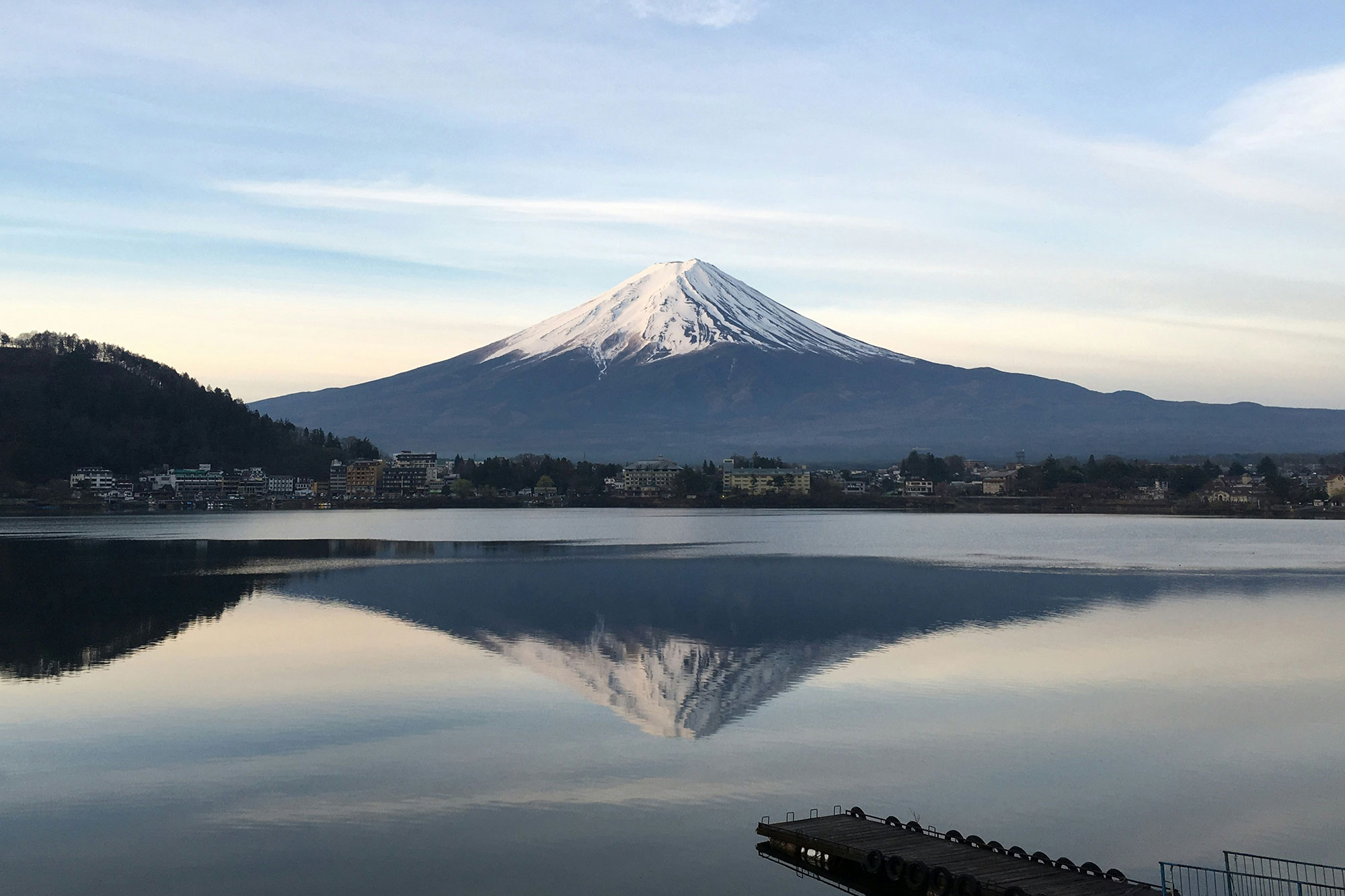
The first time in Japan
I can already tell you, it won't be your last time in Japan, because once you've traveled to Japan, you will come back again.

Luggage service in Japan
Travel comfortably around without having to constantly carry your heavy suitcase. That's what the luggage service does for you.

Japan Rail Pass for tourists
Is the Japan Rail Pass the best choice for traveling through Japan? Find all the information about ordering, costs, and procedures here.

Traveling through Japan with the Shinkansen
Traveling through Japan on the high-speed Shinkansen train is a highlight. Here you'll find all the information about ticket purchase and riding the Bullet Train.
Questions, tips or notes?
Write a comment or send me an E-Mail…
Related posts
The first time in Japan
I can already tell you, it won't be your last time in Japan, because once you've traveled to Japan, you will come back again.
Luggage service in Japan
Travel comfortably around without having to constantly carry your heavy suitcase. That's what the luggage service does for you.
Japan Rail Pass for tourists
Is the Japan Rail Pass the best choice for traveling through Japan? Find all the information about ordering, costs, and procedures here.
Traveling through Japan with the Shinkansen
Traveling through Japan on the high-speed Shinkansen train is a highlight. Here you'll find all the information about ticket purchase and riding the Bullet Train.
Questions, tips or notes?
Write a comment or send me an E-Mail…