


Getting from South Korea to Japan doesn’t always have to mean flying. With the Panstar Cruise ferry “Miracle” you sail from Busan to Osaka overnight. You get your own cabin, a buffet in the evening and in the morning, and you travel through the Seto Inland Sea. How exactly this unforgettable adventure works, what it costs and which tips you need, you’ll find out right here. By the way: you can sail the exact same route in the opposite direction, from Osaka back to Busan.
Fares & Cabins
The price depends on the cabin category. There is something for every budget. Here is an overview of the different cabin types and fares that Panstar Cruise offers on this route:
- Inside Room: inside cabin without a window for max. 4 people – approx. 200,000 Won per person
- Ocean View: same as the Inside Room, but with a window and a view of the sea – approx. 250,000 Won per person
- Balcony Suite: private balcony and a proper bed for max. 2 people – approx. 500,000 Won per person
- Royal Suite: more spacious than the Balcony Suite, for max. 2 people – approx. 700,000 Won per person
- Presidential Suite: the top category, of which there is only a single room – approx. 1,200,000 Won per person
What the category means for the food
The breakfast and dinner buffets are included in the price for all passengers, no matter which cabin you sleep in. From the suites upwards there is an additional dining service, and the sought-after window seats in the restaurant are reserved for VIP guests. So in the highest category you really do get different food served, not just a better seat. The regular buffet is very generous though and genuinely good for a ferry. I would definitely not recommend a higher category just for the choice of food.
Tip on choosing a cabin
Book an Ocean View cabin for around 150 € per person. They are designed for four people, but they are usually not fully booked. In practice there will be two of you in a cabin meant for four. So you pay the normal price and get more space. For a crossing of around 17 hours that is perfectly sufficient. Better save the money and spend more on shopping in Japan.
Booking tickets
You book directly with the operator at www.panstarcruise.com. You first have to create an account there, only then can you complete a booking. The ticket is then placed in your account as an e-ticket. So there is nothing to print out or pick up anywhere, it is simply sitting in your user area.
Important when planning
The ferry does not run daily. From Busan it only departs on Sunday, Tuesday and Thursday. So check the departure days early and build your route around them, otherwise in the worst case you will be waiting two days in Busan. You should also book the ferry well in advance. A few months ahead is best.
Getting there and check-in
The ferry departs from the Busan Port International Passenger Terminal, the city’s international ferry terminal. Getting there is really easy. Just take the bus straight to the ferry terminal, several lines go there. You pay as always with the Tmoney Card. Plan enough buffer, traffic in Busan can get extremely slow at rush hour.
The check-in procedure is reminiscent of an airport: pick up your ticket, drop off your luggage, go through security and then on board. You should look up the times beforehand, because they depend on the day of the week. On Sundays the ferry leaves earlier than on Tuesdays and Thursdays. Your ferry to Osaka is the Panstar “Miracle”.
The most important thing
You have to fill in the immigration forms that you receive with your ticket at the counter. Digital entry to Japan, which you know from the airport, does not work on this route. Visit Japan Web is of no use to you here, even if you have already done it in advance. On arrival in Osaka only these paper forms are accepted.
The Route
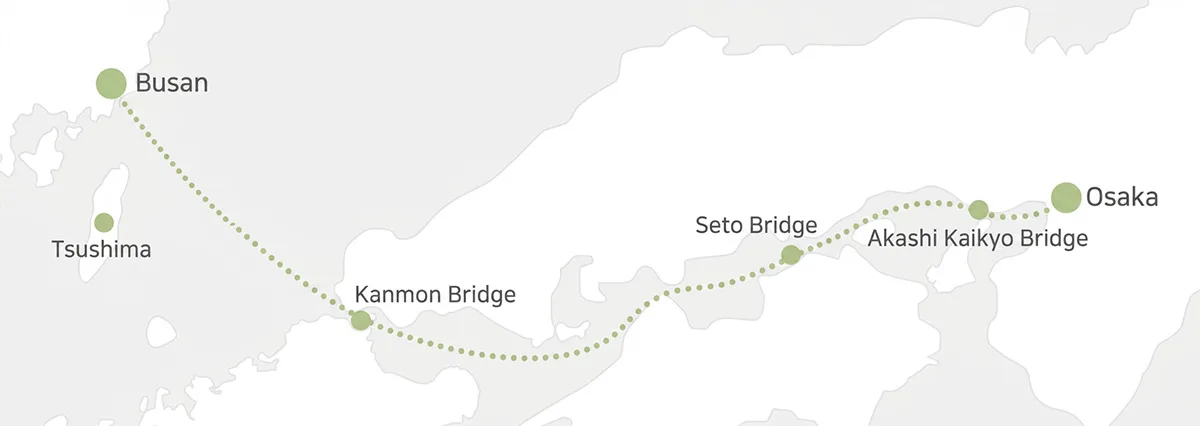
The ferry takes about 17 hours for the roughly 500 kilometres between Busan and Osaka. After casting off you first pass Tsushima across the Korea Strait. That is already the end of the open stretch, because after a few hours you reach the Japanese coast and sail under the Kanmon Bridge, which connects Kyushu with Honshu. From there the route runs through the Seto Inland Sea.
On board
Settling in and casting off
First you move into your cabin in peace and stow your luggage. Then head out on deck and watch the ship cast off. And as Busan slowly disappears on the horizon, you do get a little wistful, surrounded by all those memories of South Korea. At the same time the anticipation of Japan grows.
Exploring the ship
After that you have plenty of time to look around and explore the whole ship. Find out where the restaurant is. Drop by the lounges or grab a few snacks. If it isn’t too cold for you, jump into the pool on deck and enjoy a turn in the whirlpool. Take the time to walk around everything once before it gets dark.
Dinner
In the evening a generous buffet awaits you. There is a mix of traditional Japanese, spicy Korean and classic Western dishes. From fresh regional ingredients to popular international classics, there is something for every taste.
Entering the Seto Inland Sea
After a good four hours you already reach Japan. Make sure to head out on deck once more and watch the ferry sail under the Kanmon Bridge into the Seto Inland Sea. Islands and lights appear to the left and right, and the feeling that the journey is only just getting started is hard to describe. After that there isn’t much left to see for a while. Make yourself comfortable in the soft beds, which are surprisingly cosy. You can easily regulate the fresh air for sleeping via the ceiling vent.
The highlight in the morning: the Akashi Kaikyo Bridge
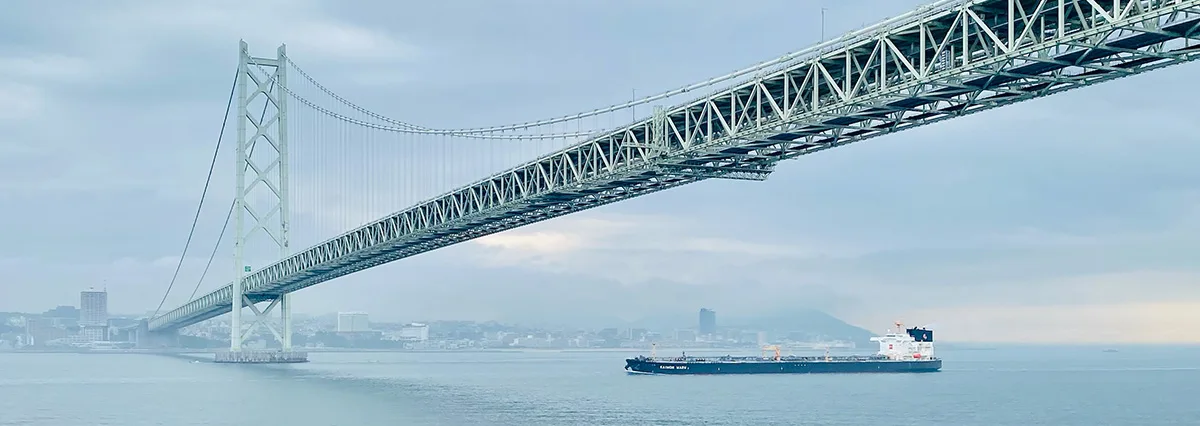
After breakfast in the morning, the most impressive moment of the trip awaits. The ferry passes the Akashi Kaikyo Bridge (明石海峡大橋), the suspension bridge between Kobe and the island of Awaji. With a main span of almost 2,000 m it was the longest suspension bridge in the world until 2022 and is still the third longest today. You sail directly underneath it, and from the perspective of the deck the structure looks enormous. It is the last bridge before Osaka, after that only the bay opens up. So have breakfast, grab your camera and be on deck in good time. You don’t want to sleep through this moment.
Check-out in Osaka
You dock directly at the ferry terminal in Osaka, the Osaka Nanko International Ferry Terminal in the port area. After that everything goes quite quickly. There are far fewer people than at an airport, so the queues are correspondingly short. Hand in the two forms, one at immigration, the other at customs. So be sure to keep both until the very end and don’t throw them away on the ship.
Don’t worry, you won’t be left stranded out there: right at the terminal exit free shuttle buses are waiting to take you to the nearest metro station. From there you simply continue into the centre by metro. That puts you into the public transport network within a short time of getting off, considerably more relaxed than many an airport transfer.
And then have a great time in Japan!
Related posts
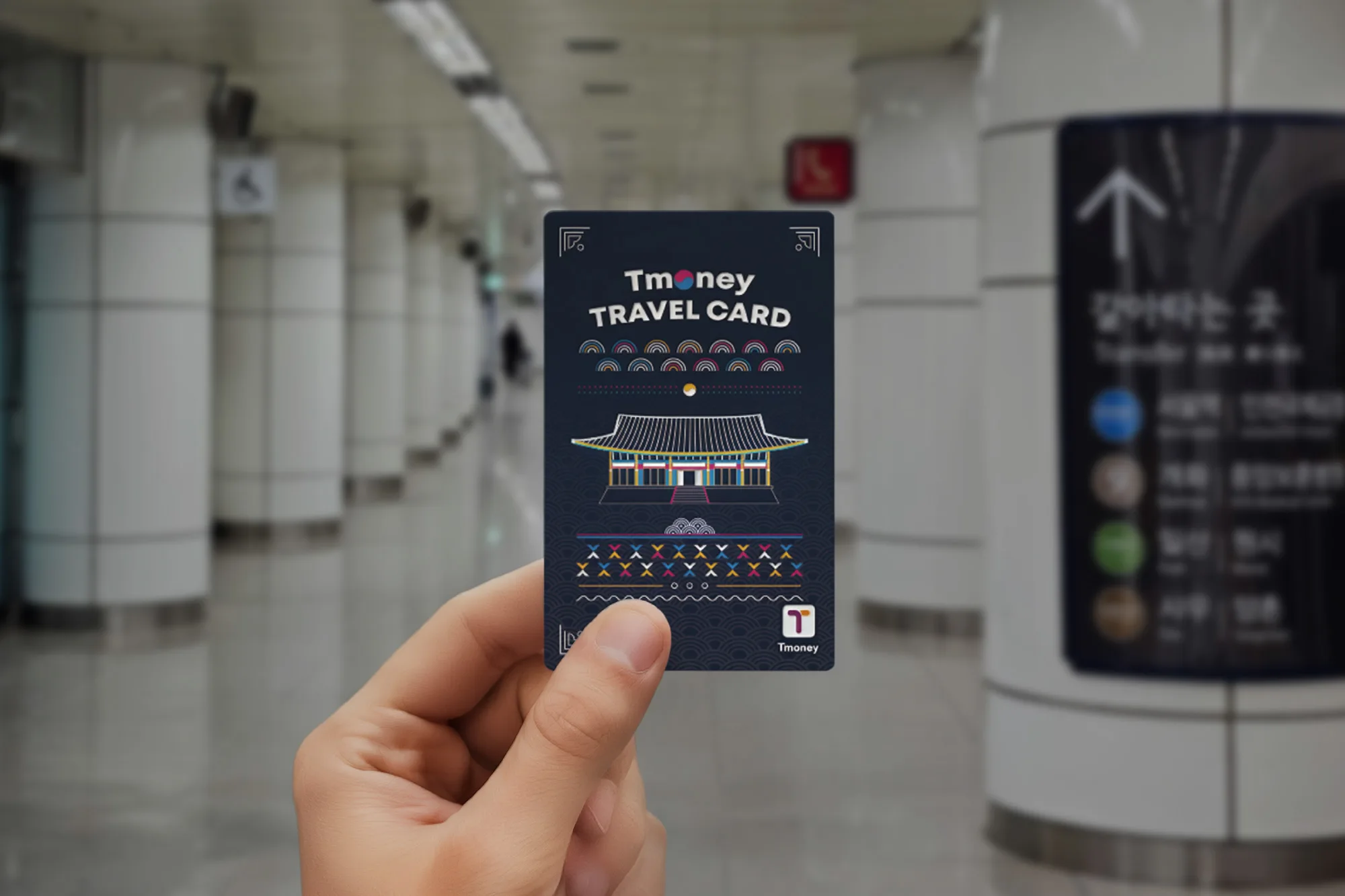
Tmoney Card – Prepaid Card in South Korea
The Tmoney Card is South Korea's prepaid card for buses, trains and paying in shops. How to get it, top it up and use it - including on your iPhone.
Internet in Japan – SIM card or eSIM?
The easiest way to access the internet on your smartphone in Japan is with a foreign SIM card or eSIM. This is how you get and install a SIM.
The first time in Japan
I can already tell you, it won't be your last time in Japan, because once you've traveled to Japan, you will come back again.
Budget Japan Trip – Money Saving Tips
A Japan vacation doesn't have to cost a fortune! Make your Budget Japan Trip a reality with these tips for flights, food, and hotels.
Questions, tips or notes?
Write a comment or send me an E-Mail…