


Monkeys sitting relaxed in a steaming hot spring while everything around them is covered in snow. You have definitely seen that photo. It is taken at the Jigokudani Yaen-koen near Nagano, and yes, you can get there as an ordinary visitor. How you get there, why the ticket machine at the station is the biggest obstacle and what you absolutely have to watch out for on site, you will find out here.
Getting there from Nagano
The starting point is Nagano Station. Coming from Tokyo you are in Nagano in around 90 minutes with the Hokuriku Shinkansen. But do plan a few days in Nagano anyway. There is so much more to see here than just the snow monkeys. Everything about travelling by train is here: Traveling through Japan with the Shinkansen and about the pass here: The Japan Rail Pass for tourists.
Important: the ticket machine
If you are in a hurry, hunting for the right machine can get hectic. Several floors, and counters and ticket machines everywhere. For the Shiga Kogen Express bus to the monkey park there is a separate ticket office with its own machines. It is not in the station hall but on the ground floor 1F outside at the East Exit (東口), so the back exit. The whole thing is called Aruyo and it is the ticket centre of the Nagaden buses. From there it is only a few metres to bus stop 23, where the Shiga Kogen Express bus departs. Have a look at the short video too, it shows the easiest way to find the counter.
What it costs
A one way trip to the Snow Monkey Park stop costs 2,000 yen, so 4,000 yen return per person. The ride takes about 45 minutes.
A different bus runs in winter
Watch out: from 5 December to 5 April the regular Shiga Kogen Express bus does not stop at the Jigokudani Yaen-koen. During that time the separate Snow Monkey Park Express bus runs instead, and it goes a lot more often per day. It still departs from the East Exit. Check the current timetable before you set off anyway, the times change with the season. You will find the official page here: snowmonkeyresorts.com
The walk to the park
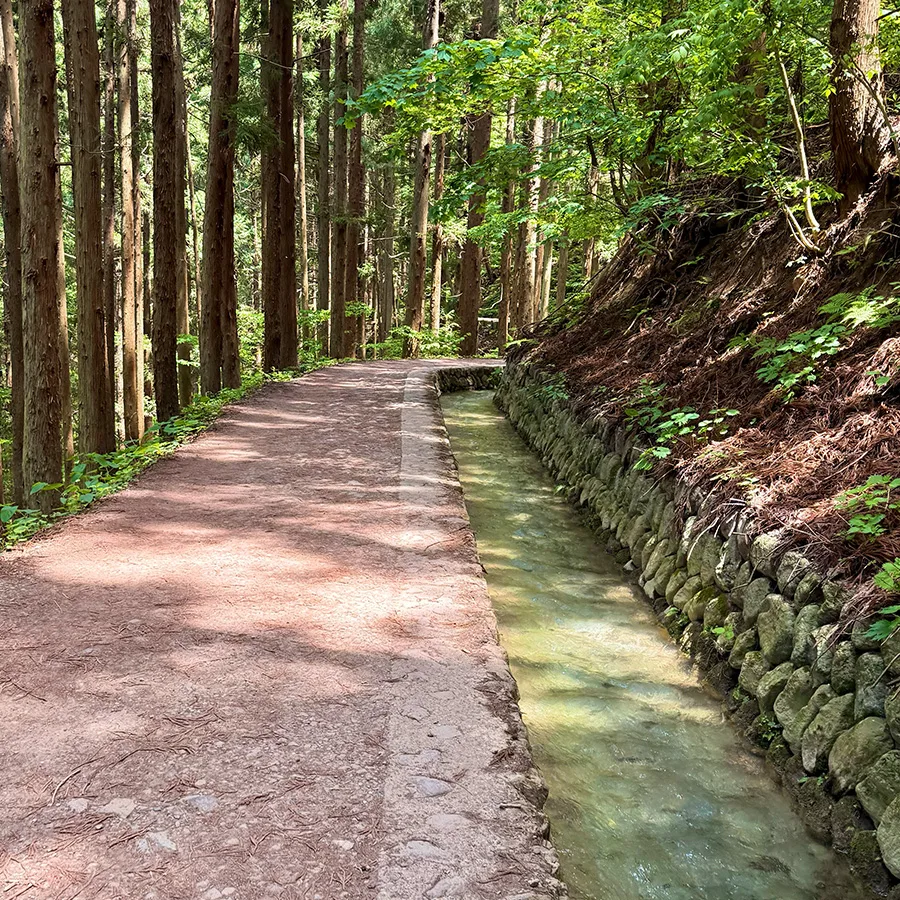
The bus does not stop right at the Jigokudani Yaen-koen, but a good distance before it. From the car park you first walk through the village to the entrance of the forest, and that is where the actual trail starts.
The trail itself is about 1.5 kilometres long and takes you a good 30 minutes, in winter rather more. Together with the stretch from the bus to the forest entrance you should plan 45 minutes in total, and that is in each direction. Keep that in mind on the way back if you do not want to miss the bus! Better to set off a quarter of an hour earlier than you think.
The trail leads through the forest, is unpaved and only climbs noticeably over the last few hundred metres. In winter it is icy, then you need shoes with a proper grip. You can also rent spikes to pull over your shoes on site.
Behind the forest it gets spectacular
After the forest you come out right at the river, and here it becomes immediately clear where the name comes from. Jigokudani means hell valley. Everything hisses and steams and boiling hot water shoots out of the ground. Right in the middle stands the ryokan Korakukan, the only house up here. From there a path leads up to the actual entrance of the park.
The monkeys in the hot spring
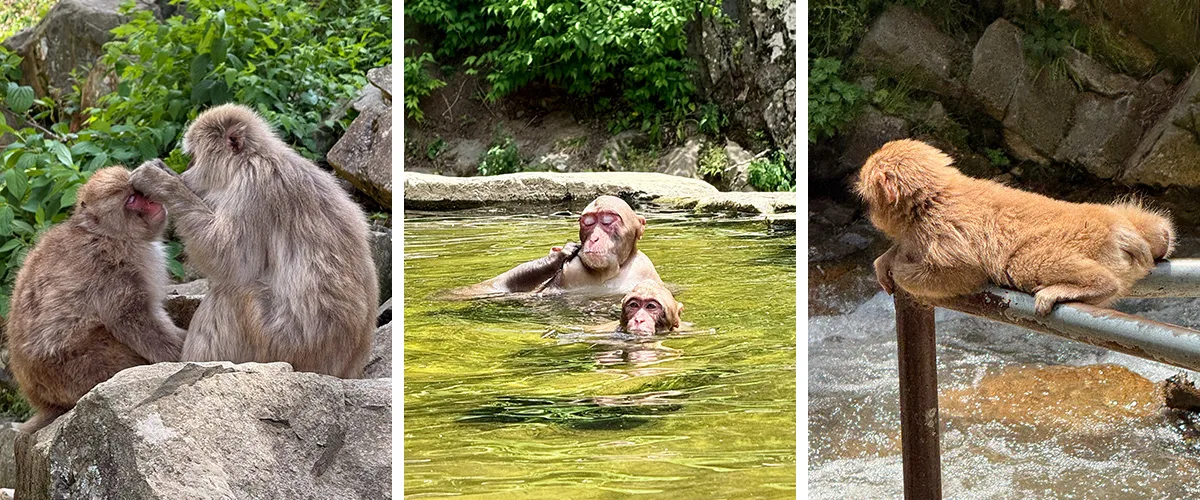
The park itself is small and you are through it in a few minutes. But there are monkeys everywhere. On the path, on the walls, on the railings and right next to you. There are no fences and no enclosures, the animals are free and come down here of their own accord.
They are Japanese macaques, also called snow monkeys. They live further north than any other monkey in the world. At the end of the park you then see THE pool that you know from countless photos. There they sit in the steaming water, groom each other’s fur and ignore you completely. The bathing mainly happens when it is cold. The best months are January and February, snow usually lies from December to March. In summer the pool is often empty, simply because it is too warm. The keepers then sometimes throw food into the water so that something happens at all. It can well happen that not a single one turns up on a given day.
Opening hours and admission
Open daily, from April to October 8:30 am to 5 pm, from November to March 9 am to 4 pm.
Admission around 1,000 yen for adults and around 500 yen for children.
Rules of conduct
The rules were tightened in 2026, and there are reasons for that. Visitor numbers have at times shot up to 3,000 to 4,000. Unfortunately there were also guests who wanted to feed the monkeys, touch them or even get into the pool with them. Stick to the following:
- Do not feed them. Never, not even secretly.
- Do not touch them and do not pet them.
- Keep at least 1 to 2 metres distance.
- Do not get into the water. The pool is not an onsen for humans. If you want to bathe yourself, you will find proper onsen here: The most beautiful onsen in Japan
- Do not eat or drink in the park or on the trail. Even an open water bottle in your hand is an invitation.
- Do not stare the monkeys in the eyes. Among macaques direct eye contact counts as a threat.
- No flash and no selfie sticks.
- Do not bring dogs or other pets.
These are not friendly suggestions. They are wild animals with a powerful set of teeth, and if they feel cornered they can get aggressive and bite. During our visit there was an American who absolutely had to try it out. Since then I also know how big monkey teeth can be. He was sent out by the staff as well.
Insider tips
Check the live camera first
The park runs an official live camera pointing straight at the pool. On top of that the website has a forecast of how active the monkeys are in the current week. Have a look in the morning, before you buy your bus ticket at the station: Live camera and current situation at the Jigokudani Yaen-koen
Better buy the park ticket online
Web tickets have been available since August 2026, and with the price increase from December 2026 they are worth it twice over. Online you only pay 880 yen instead of 1,000 yen at the counter, for children 440 instead of 500 yen. More importantly: from December to April guests with a web ticket get priority entry. When it is busy, without a ticket you may not get in at all. The ticket is valid for a fixed date and can be booked up to three months in advance: Web ticket for the Jigokudani Yaen-koen
Related posts

Most beautiful Onsen in Japan
Discover the most beautiful Onsen in Japan: From idyllic mountain villages to hidden river springs – incl. access tips.

All about Onsen in Japan
Onsen (温泉) are hot springs that have a long tradition and are considered an integral part of Japanese culture. Find out all you need to know about these natural thermal baths.
Taking the bus in Japan
Bus travel in Japan is a widespread transportation option used in urban areas as well as in rural regions.
Budget Japan Trip – Money Saving Tips
A Japan vacation doesn't have to cost a fortune! Make your Budget Japan Trip a reality with these tips for flights, food, and hotels.
Questions, tips or notes?
Write a comment or send me an E-Mail…