


Yamagata is on hardly any Japan itinerary, and that is exactly why it is worth it. An onsen town that looks like it came straight out of a Ghibli film, a temple high up in the rocks with 1,000 steps in front of it, an old pilgrim route across three sacred mountains and an aquarium that saved itself from going under with jellyfish. What is really worth your time, what you can skip and how to best get around there, you will find out right here.
Where is Yamagata?
Yamagata lies in the north of Honshu, in the Tohoku region. Its neighbours are Akita to the north, Miyagi to the east, Fukushima to the south and Niigata to the southwest. It is the ninth largest prefecture in Japan, but has just under 1 million inhabitants.
Yamagata is largely mountainous. The Zao with its crater lake Okama, the Gassan, where up to 3,000 cm of snow can fall in a season, the Chokai on the border with Akita and the three mountains of Dewa. The Mogami, one of the fastest rivers in Japan, winds through the middle. In terms of agriculture, Yamagata is Japan’s largest cherry producer. If you are there in June you will get cherries everywhere.
Getting there
Getting there is really easy. From Tokyo the Yamagata Shinkansen takes you straight to the city of Yamagata in around 3 hours without changing trains. The train is called Tsubasa and is a so called mini shinkansen. From Tokyo it is coupled to a train on the Tohoku line, in Fukushima it is uncoupled and trundles on from there on normal tracks to Yamagata and up to Shinjo. When you board, watch out for the right carriage, because the rear part of the train carries on north. Everything about travelling by train is here: Traveling through Japan with the Shinkansen and about the pass here: The Japan Rail Pass for tourists.
On site: take the car
From Yamagata you can carry on by bus, but honestly it is tedious. The sights are far apart and up in the mountains the buses only run rarely. With a rental car you are a lot more flexible and save yourself plenty of waiting. What you need for that is here: Traveling by car in Japan. See also Kyūshū Road Trip on Japan’s Third Largest Island
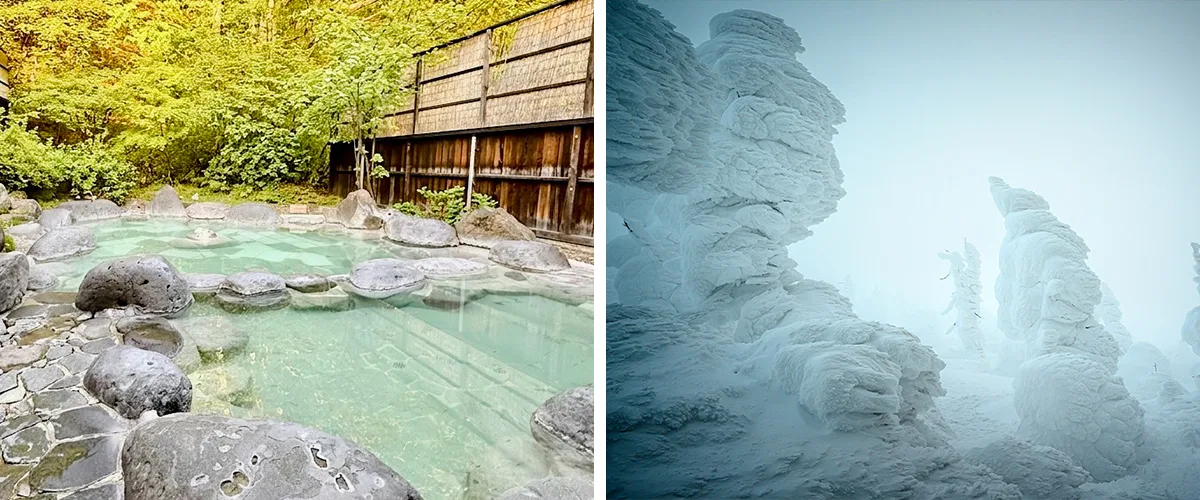
Zao Onsen
Honestly, Zao Onsen was a disappointment. The plan was a relaxed onsen town, because they can be so beautiful, see also The most beautiful onsen in Japan. Unfortunately Zao Onsen is not one of them.
Wellness in an acid bath
What we did not know beforehand: the springs in Zao are among the most acidic in all of Japan. Depending on the spring the pH value is around 1.6 to 1.9. That is roughly the pH value of stomach acid. The water is milky blue and smells distinctly of sulphur. After 15 minutes at the most you have to get out. Usually it starts stinging everywhere before that. On irritated skin you notice it immediately. Relaxing looks different.
Dead quiet in summer
The town lives off the winter. When we were there in summer most restaurants were closed and there was practically nobody on the streets. All that was left was the drive all the way down into the valley to go and eat in Yamagata city. There is a konbini in the village though, as always the lifesaver.
In winter it looks different
Then Zao is a popular ski resort and above all the home of the snow monsters. That is what the locals call the juhyo, conifers that turn into bizarre white figures under a thick layer of snow and rime. The ropeway takes you towards the summit of the Jizo and you stand right among them.
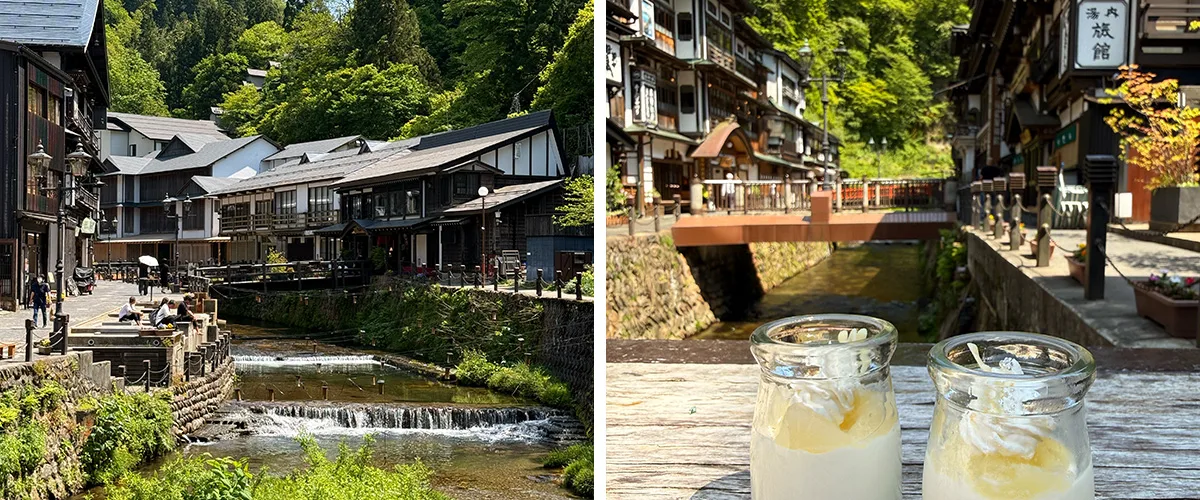
Ginzan Onsen
Ginzan Onsen is the postcard motif of the prefecture and really does look like something out of a Ghibli film. Guest houses made entirely of wood stand on both sides of a narrow river. In the evening when it gets dark the historic gas lanterns come on. But that is exactly why the place is so crowded.
You cannot get in by car
You should be prepared for this. As a day visitor you have to park at the Taisho Romankan visitor centre around two kilometres outside. From there a shuttle bus takes you in for a fee. In the winter season there is also a fixed visitor system with time slots, quotas and mandatory reservations for the evening hours. The exact rules and prices change from season to season. It is best to check the official website ginzanonsen.jp shortly before your visit.
Bathing is harder than you think
When it comes to bathing most day visitors are disappointed. The beautiful baths in the ryokan are reserved for overnight guests. As a day visitor all that is left is the public onsen at the entrance to the village. But that one is really tiny and not recommended. If you want a bit of onsen feeling you can really only fall back on the small hot foot baths in the village.
My advice
Decide on one of the two beforehand. Either you stay overnight there, then you have the place almost to yourself in the evening after the daily rush and you get into the good baths. Or you make a short detour of one to two hours, take a few photos and sit down in a foot bath. The village itself is small and quickly walked.
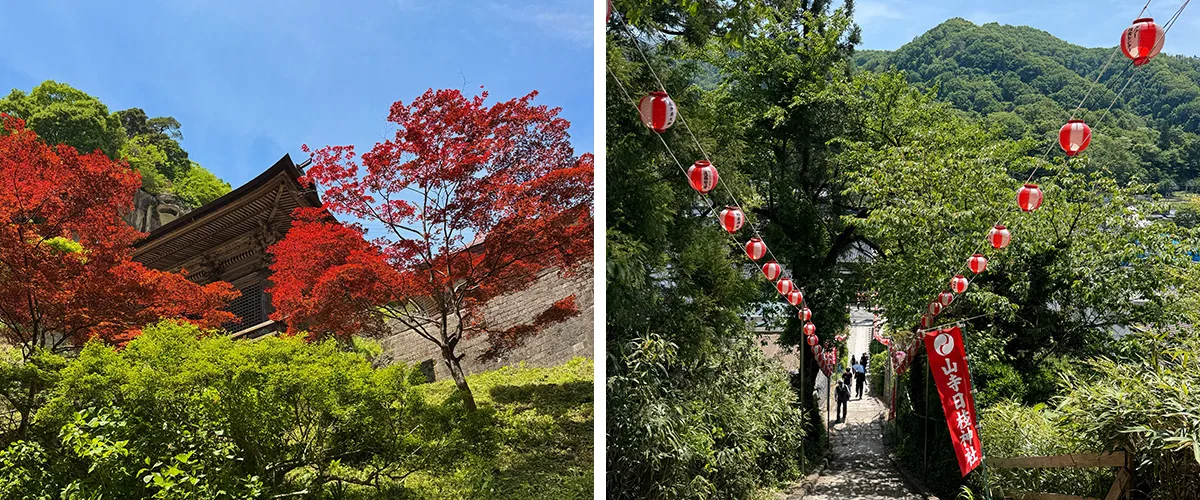
Ryūshaku-ji
The Ryūshaku-ji, often simply called Yamadera (mountain temple), was my highlight in the whole region. The temple buildings cling to a steep rock face above the valley. Stairs lead up through crevices in the rock and cedar forests. Admission is around 600 yen. Opening hours are usually 8 am to 5 pm. You can park easily in one of the car parks in the village. There is almost always a space free here.
1,000 steps up and back down
To be precise it is 1,015 steps up to the temple. That sounds a bit off putting at first. I had my doubts beforehand too about whether I would manage it. In fact at a leisurely pace you only need 30 to 45 minutes to get up. You stop every few metres anyway because there is always something to look at. It is more of a walk with lots of breaks.
Once at the top the Godaido viewing platform juts out over the slope. From there the view goes across the whole valley with the river and the railway line. That is the moment you walked up for. In autumn with the foliage it is supposed to be another thing entirely.
A bit of background
The temple was founded in the 9th century. But it became famous through the poet Matsuo Basho, who wrote a haiku about the silence of the place in 1689 on his journey through the north. Every Japanese school child still knows it today. The stone with the verse stands halfway up along the path.
My tip for afterwards
Down in the village there is a small café run by a very likeable Australian woman: the Nice Spot Coffee. Good coffee and a tasty miso brownie, exactly the right thing after 1,000 steps back down. You can see what is on offer right now on her Instagram page.
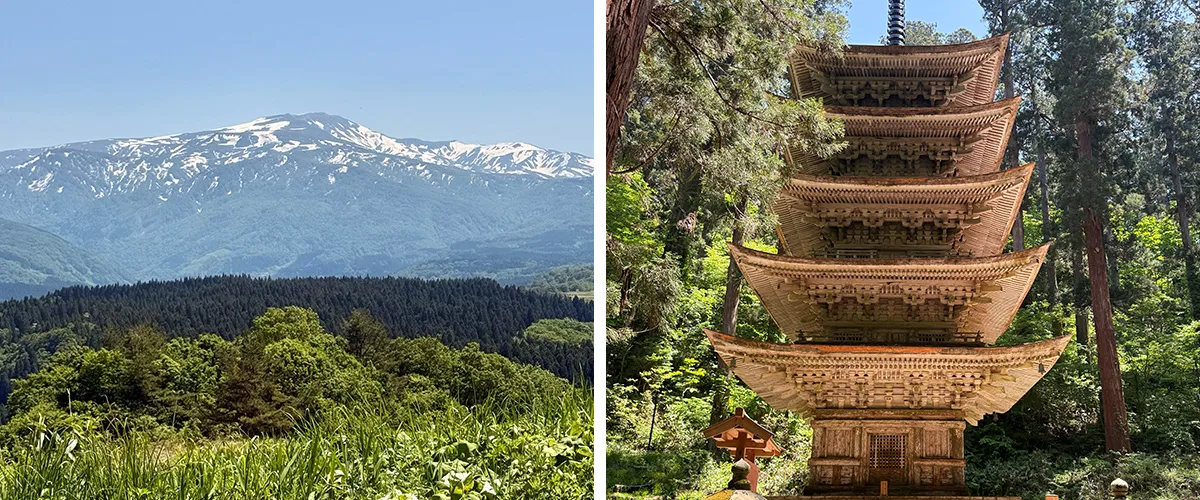
The three mountains of Dewa
The Dewa Sanzan are three sacred mountains, Haguro, Gassan and Yudono, and have been a pilgrim route for centuries. The Haguro is seen as the gateway to the three, the Yudono as the innermost sanctuary, and up on the Haguro stands the hall Sanjingosaiden, in which the deities of all three mountains are worshipped together.
The pagoda at the entrance
The real eye catcher comes right at the start. After the entrance gate you walk through a cedar avenue with ancient trees. As your entrance ticket you get a small chain with a pendant made of real cedar wood. That wonderful natural scent will accompany you the whole way. Before it goes up the mountain there stands the five storey cedar wood pagoda, completely without paint. It is a national treasure and is considered the oldest pagoda in the Tohoku region. Right next to it stands the grandfather tree Jijisugi with around 1,000 years on its back.
Two ways to the summit
- Only up to the pagoda and by car to the top: that is a short and relatively flat path. Only at the beginning are there a few steps. There and back takes a good half hour. After that you drive straight up the toll road to the summit. Costs around 400 yen.
- The complete ascent on foot: there are around 2,500 steps to the summit. Reckon on one to two hours of climbing.
We took the combination, on foot to the pagoda and then up by car. That way you have seen both, the avenue with the pagoda and the hall at the top.
What awaits you at the top
Once at the top you stand on a wide square and the eye catcher is immediately the Sanjingosaiden, in which the deities of all three mountains are worshipped together. It was built in its present form in 1818 and is an important cultural property. The impressive part is the thatched roof, 2 m thick. In front of the hall is the mirror pond Kagami-ike, into which bronze mirrors have been thrown as offerings since the Heian period. The museum on the grounds shows exactly these mirrors along with other finds.

Kamo Aquarium
An aquarium sounds like a bad weather programme at first. But the Kamo Aquarium near Tsuruoka is a real sight.
How jellyfish saved an aquarium
The place opened in 1930 and was facing the end in the late 1990s. In one tank small jellyfish were discovered by chance and put on display. And sure enough visitors came to look at the jellyfish. Director Tatsuo Murakami bet on that and developed methods to breed jellyfish themselves. The plan worked out.
In 2005 the small aquarium overtook the Monterey Bay Aquarium in the number of jellyfish species on display and holds a Guinness world record for it. In 2014 it got a new building and in the same year 716,354 visitors came, 8 times as many as in the crisis years.
What you see
Around 60 jellyfish species are on permanent display. In total there are about 140 species in the house. Almost all of them are bred on site. You also walk right through the breeding area. There you see how the pinhead sized young develop into fully grown jellyfish. At the end you can sit down in front of a huge round tank full of moon jellyfish and simply watch them drift in circles.
Insider tips
Korean food in Tsuruoka
Our best meal in the whole region was neither Japanese nor to be found in any guidebook. In Tsuruoka an elderly Korean woman who emigrated to Japan years ago cooks in her small, inconspicuous house. From the outside it all looks more like a normal residential area. Inside you sit in her converted living room at a big table and get Korean home cooking. If you are in Tsuruoka, plan a detour: 韓国ヤ
Make your own okonomiyaki
Also in Tsuruoka is the small restaurant Sabo. There you can prepare your own okonomiyaki. A hot plate is set into the table, you get the batter brought to you with all the ingredients and do the rest yourself. Stir it, tip it onto the plate, wait, turn it and at the end top it with sauce, mayonnaise and bonito flakes. As an experience it was a really funny evening that you will not forget in a hurry. If you want to make okonomiyaki at home yourself, you will find all the information here: Okonomiyaki – Japanese soul food for your home
Cold ramen
And one last tip: Yamagata is the ramen capital of Japan. The local speciality here is called hiyashi ramen, meaning cold ramen. The whole soy sauce dashi broth is cold. Often there are even ice cubes floating in it. The season runs from June to September, some shops have it all year round. If you are in Yamagata in summer, give it a try. It really is a good refreshment on hot days.
Related posts
Kyūshū Road Trip on Japan’s Third Largest Island
Kyūshū Road Trip: all the stops with Fukuoka, Beppu, Mount Aso and Kumamoto in one week, including an onsen highlight

Most beautiful Onsen in Japan
Discover the most beautiful Onsen in Japan: From idyllic mountain villages to hidden river springs – incl. access tips.

Traveling through Japan with the Shinkansen
Traveling through Japan on the high-speed Shinkansen train is a highlight. Here you'll find all the information about ticket purchase and riding the Bullet Train.
Budget Japan Trip – Money Saving Tips
A Japan vacation doesn't have to cost a fortune! Make your Budget Japan Trip a reality with these tips for flights, food, and hotels.
Questions, tips or notes?
Write a comment or send me an E-Mail…