


A Kyūshū road trip is the Japan trip for everyone who wants to do something different the second time around than the classic Honshu round trip with Tokyo and Kyoto that you do on your first visit. On Kyūshū you get steaming hell springs, a volcano sitting in one of the largest calderas in the world, a completely underrated city of over a million, and a road that disappears into the sea twice a day. How to get there, why you should definitely rent a car and which stops are worth it on a road trip, you will find out right here.
Where Kyūshū is and how to get there
Kyūshū is the southwesternmost of the four main Japanese islands and, after Honshu and Hokkaido, the third largest. Only the narrow Kanmon Strait separates it from Honshu, and that is exactly where the Shinkansen passes underneath. Your gateway to the island is Hakata Station in Fukuoka.
By Shinkansen to Hakata
Hakata is the final stop on the Sanyo Shinkansen line. From Shin-Osaka the Nozomi gets you there in around two and a half hours, from Tokyo it takes about five hours. In Hakata the Kyūshū Shinkansen then begins, heading on towards Kumamoto and Kagoshima.
Important for your planning: The fastest trains, Nozomi and Mizuho, are not simply covered by the Japan Rail Pass, you pay a surcharge for them. Sakura and Kodama are covered, but take longer. Everything about the pass is here: The Japan Rail Pass for tourists, and about the Shinkansen in general here: Traveling through Japan with the Shinkansen.
My tip: one week by car
For Honshu I recommend trains and buses. On Kyūshū it is different. The best stops lie between the cities, at the volcano, on the coast, up in the mountains, and getting there by public transport takes a lot of patience. One week is plenty for a round trip through northern Kyūshū. If you want to see the south as well, plan more time.
Renting a car
This is surprisingly straightforward. You usually do not have to leave a deposit and the handover takes less than ten minutes. What really matters is the preparation. More on that here: Traveling by car in Japan.
Driving
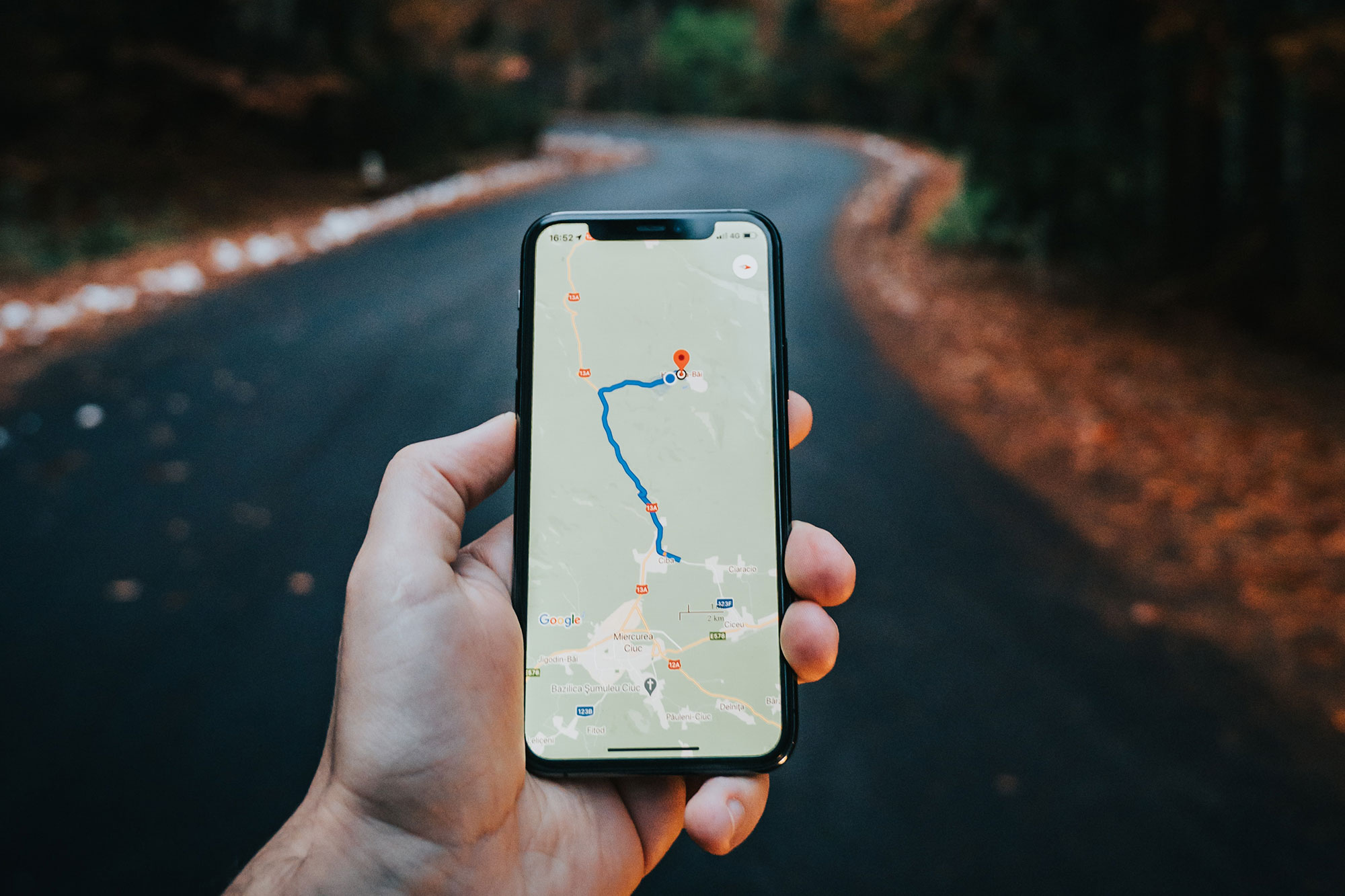
There is exactly one thing you need to watch out for: driving on the left. The rest is more relaxed than at home. Everyone drives very defensively and nobody pushes. You get used to the leisurely pace faster than you would think. After half a day you stop thinking about it. Navigation works perfectly well with Google Maps or Apple Maps. Best get yourself a SIM card for the road trip so you can navigate just like at home. More info: Internet in Japan, SIM card or eSIM?
Traffic lights
Two quirks that will confuse you at first. At intersections the lights usually hang on the opposite side, not next to you at the stop line. And they are mounted horizontally instead of vertically. Fun fact: vertical traffic lights only exist in Hokkaido and Tohoku, so that snow cannot pile up on the visors.
Tolls
You have to pay tolls on Japanese expressways. Payment is either electronic via an ETC card or manual at the toll booth. Rental cars basically never come with an ETC card. So always carry enough cash. Some booths do take credit cards or prepaid cards, but do not count on it.
Note: The on-ramps are the tricky part. There are so-called Smart Interchanges that can only be used with ETC. Without an ETC card you will not get through the barrier and have to find another entrance.
Service areas
In Japan these are not a last resort, they are a destination in their own right. Instead of stale hot dogs you get freshly cooked food, often with regional specialties from the prefecture you are driving through. It makes the breaks genuinely fun.
Fukuoka
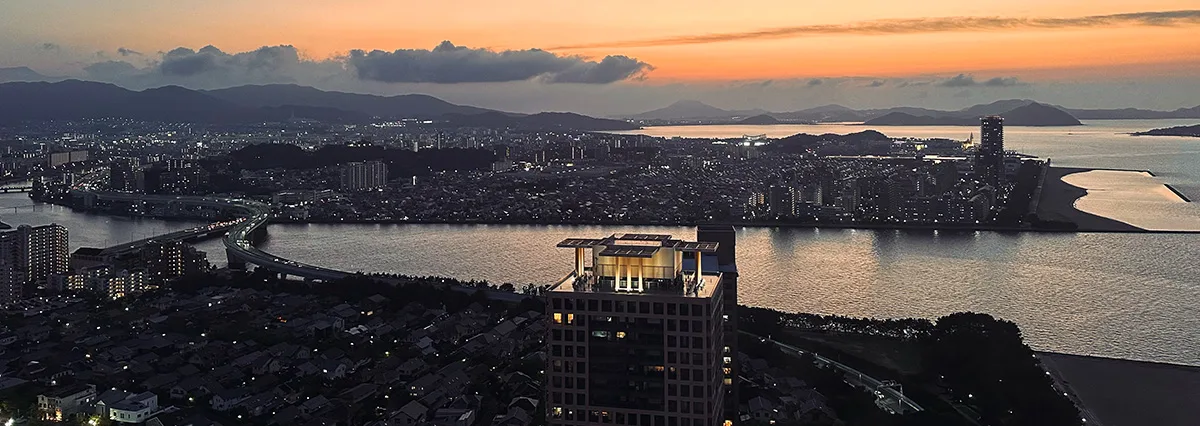
Fukuoka is the starting point for your Kyūshū road trip. For me it was the most beautiful spot of the whole trip and probably the most underrated big city in Japan. It has over 1.5 million inhabitants, sits right on the sea and feels noticeably more relaxed than Tokyo or Osaka. This is what you should definitely do:
Street food by the river
In the evening, from around 6pm, several spots in the city turn into little street food markets. This is the Fukuoka experience. Almost every other city in Japan has done away with its street kitchens. In Fukuoka there are still around 100 stalls left, the so-called yatai. Nakasu is the best known district and sits right on the bank of the Naka river. Just stroll along the water and sit down wherever you like the look of it. Note: It is cash only. Alternatively you can grab something at a konbini and make yourself comfortable on the riverbank, watching the boats and the sparkling lights.
Ohori Park
A former castle moat, today a large lake in the middle of the city with islands and bridges. Three islands sit in the pond, connected by stone bridges, and that walk straight across the water is what makes it special. A path runs all the way around it, where half the city jogs and strolls. If you have a bit more time, the Japanese garden in the south is worth it.
Fukuoka Tower
At 234 m the tallest seaside tower in Japan. The facade is made of around 8,000 half-mirrored panels, which is why the tower is nicknamed the Mirror Sail. Depending on the time of day and the weather it changes color completely. The lift takes you up to the observation deck at 123 m. From up there you get a panoramic view over Hakata Bay and the whole city. Open daily from 9:30 to 22:00 and admission is around 1,000 yen. My tip: Go up about an hour before sunset, then you get some daylight, the blue hour and the illuminated city all in one visit.
Tonkotsu ramen
Fukuoka is the home of Hakata ramen with its creamy tonkotsu broth and thin, firm noodles. It simply belongs here. The broth is made by boiling pork bones hard for hours. That is where the milky color comes from. On the table you will usually find pickled red ginger, spicy mustard greens, ground sesame and garlic. Tip: If you have some time before your Shinkansen leaves, you can grab a quick bowl of ramen right inside Hakata Station.
Beppu
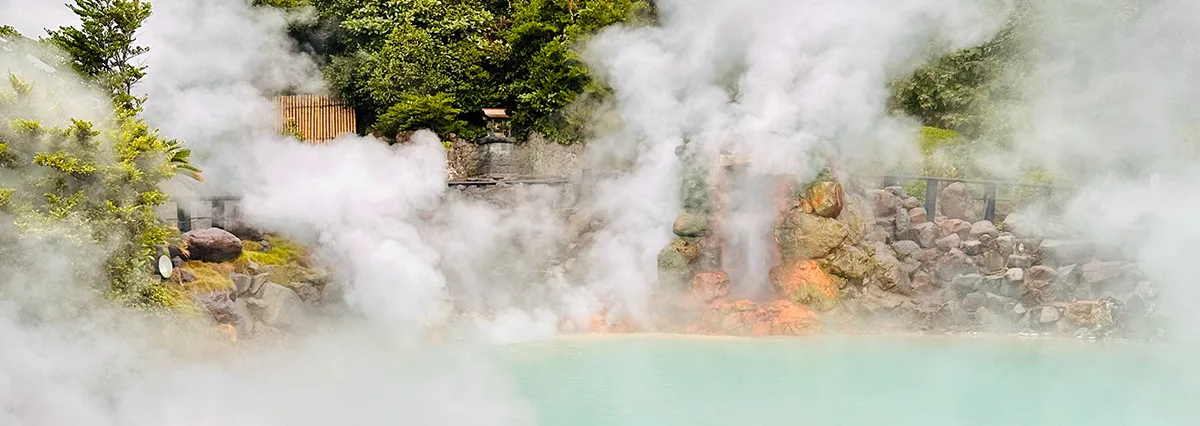
Once you have picked up your rental car in Fukuoka, the road trip begins. The first destination is around two hours east of Fukuoka. It is the city of Beppu, where steam hisses out of the ground everywhere. The city draws more hot water than any other place in Japan. Thanks to the geothermal activity the ground stays warm even in rain and cool temperatures, a bit like underfloor heating. Do not miss this.
The seven hells
The Jigoku Meguri is the classic tour through seven hot springs that are there to be looked at, not bathed in. For all of them together you need a good two to two and a half hours.
- Umi Jigoku, the sea hell: a vivid cobalt blue, the usual starting point
- Oniishibozu Jigoku: bubbling grey mud blisters that look like monks’ shaven heads
- Kamado Jigoku: several pools, one of which changes color with the temperature and weather
- Oniyama Jigoku: Japan’s first crocodile farm, with around 80 animals
- Shiraike Jigoku, the white pond hell: milky pale blue, with a tropical aquarium
- Chinoike Jigoku, the blood pond hell: rust red mud, the oldest natural hell in Japan
- Tatsumaki Jigoku: the only geyser, erupting every 30 to 40 minutes
Steam your own food
Touristy, but a highlight all the same, is the Jigokumushi Kobo in the Kannawa district. Here you get a basket with the food you ordered. All the ingredients are raw and you cook them yourself in the volcanic steam. No worries, friendly guides show you exactly what to do and when your food is done.
Kifune Castle
Kifune Castle is a little hidden gem that appears on no highlight list and still fits perfectly into the day, because it sits in the same district as the hells and the steam kitchen. It is not a genuine historic castle, the building you see today was only put up in 1957 in castle style. The really odd part waits inside. A large white snake is worshipped there, the Kinpaku Ryuo, considered a deity of wealth and good fortune. And you are actually allowed to touch it. Then there is the view. From up there you watch the steam rising over the roofs of Kannawa, with Beppu Bay, the city of Oita and Mount Tsurumi behind it.
Mount Aso
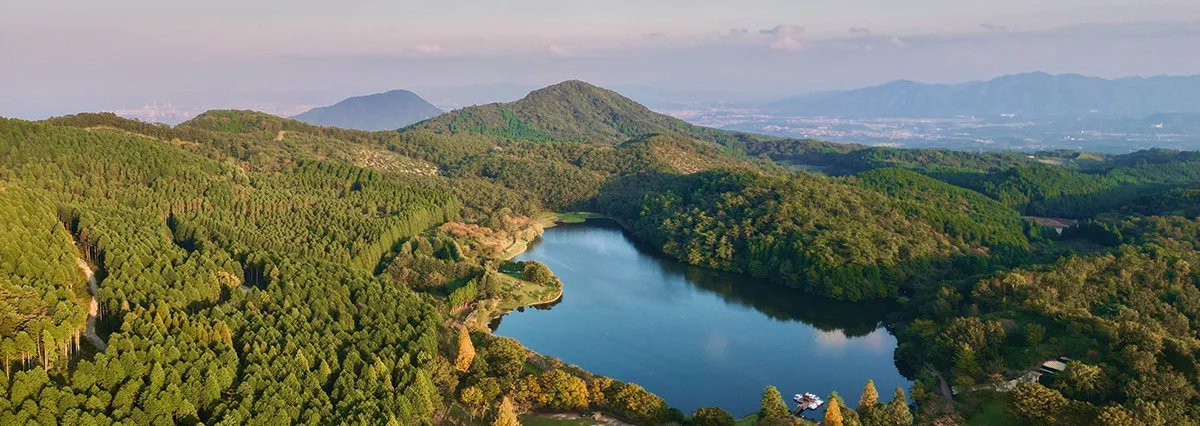
From Beppu you head further inland. Aso sits in one of the largest calderas in the world. This basin is so big that villages, fields and even entire railway lines fit inside it. Driving in, you do not notice at all that you are long since inside a volcano.
Exploring the crater
The easiest way to the Nakadake crater is by car. From the caldera a well-built mountain road winds up in wide serpentines to the Sanjo Plateau, and that drive alone is worth it: left and right the forest turns first into grassland and then into bare volcanic ash, until you arrive up at around 1,100 metres. There is a large car park at the top.
From the plateau a final stretch of toll road leads right up to the crater rim. For a normal car that costs around 800 yen. If you would rather not drive yourself, there is a shuttle bus. Up there you really do stand on the edge of an active volcano, looking down into a steaming throat. Concrete shelters are placed around the crater rim for you to take cover in should there be a sudden eruption. At the latest that is the moment you realise this is not a viewpoint like any other.
Volcanic alert level
Because the volcano is very active, there is a volcanic alert level. Depending on the level you can get up to the crater or not. If the crater is closed, you can still do the following: Daikanbo in the north is free, always open and shows you all five peaks at once. Kusasenri, the grassland with the crater lake, works at every alert level. And Komezuka, the perfectly shaped little grass volcano, sits right on the Milk Road.
Where to stay
The dream of the whole trip: Kurokawa Onsen. It is a tiny hot spring village up in the mountains, with a stream running through the middle and plenty of open-air baths. Why I love the place so much and which baths are worth it is here: Kurokawa Onsen.
Kumamoto
Kumamoto takes some getting used to. At first glance the city feels awkward and not very touristy. In hindsight it was still one of the experiences of the trip, above all because of the castle and the funny bear.
The castle
Kumamoto-jo counts as one of the three great castles of Japan, and its history is quite something. In April 2016 the castle was devastated by the severe earthquake. Since 2021 you can go inside again. It is astonishing how quickly the castle was largely rebuilt, and earthquake-proof at that. It also held up well in the recent quake in 2026. What is particularly impressive is how the collapsed stone walls are being put back together: every single stone was numbered and its position recorded in three dimensions so that it returns to exactly its old place. More than 100,000 stones have been catalogued this way. The Honmaru Goten palace is still closed on the inside due to the restoration. Admission is around 800 yen.
Kumamon
You do not have to go looking for the black bear with the red cheeks in Kumamoto, there is no avoiding him. On trams, on building facades, on traffic light boxes, on supermarket shelves, on taxis and on every second package. Kumamon was invented by the prefecture in 2010 to attract tourists after the Kyūshū Shinkansen opened. A year later he won the nationwide mascot vote. Sales of Kumamon products already reached around 29 billion yen in 2012. It is the most successful city marketing Japan has ever had. And you can actually go and visit him. Right in the middle of the city is Kumamon Square, officially his office. There you will find his desk, a small stage, a shop with merchandise, a snack corner with soft serve made from Kumamoto milk, and regular appearances by Kumamon himself.
Nagabeta Seabed Road
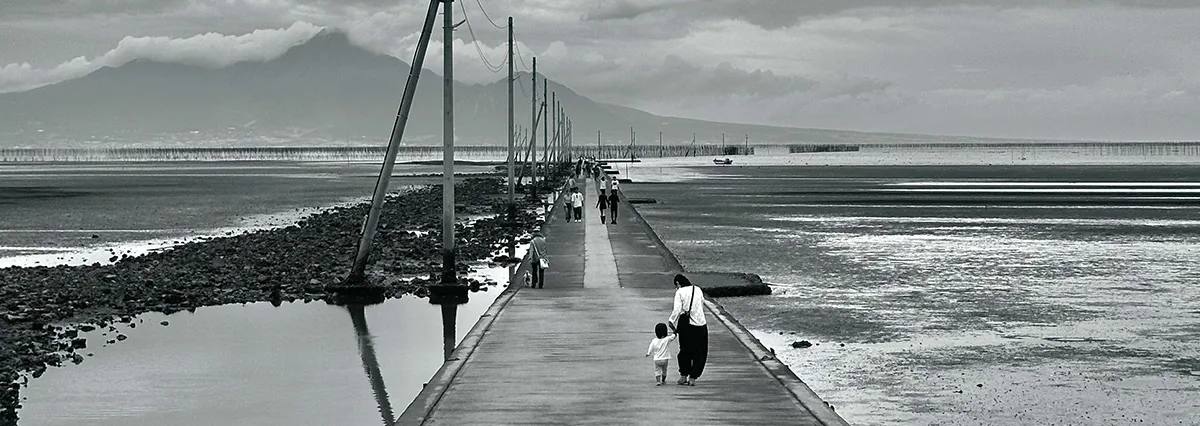
My photographic highlight of the region was around 45 minutes by car southwest of Kumamoto. There the nearly one kilometre long Nagabeta Seabed Road leads out into the sea, lined with power poles. It was built in 1979 so that fishermen could reach their nori and shellfish beds. At low tide the road lies exposed and runs dead straight out onto the open tidal flats. At high tide it disappears completely and only the poles still rise out of the water, with their lamps switched on in the evening.
Nagasaki
Nagasaki appears on a lot of Kyūshū lists, but it sits well off to the west of the route between Fukuoka, Beppu, Aso and Kumamoto. For one week in northern Kyūshū that means a noticeable detour and at least one extra overnight stop. So we skipped it. If you have ten days or more, it is worth it. With one week I would rather put the time into Aso and Kurokawa Onsen.
Insider tips
Yufuin Floral Village
Around 1.5 hours east of Fukuoka, just before Beppu, lies Yufuin. Definitely make a stop there.
In the middle of the village is the Floral Village. It is a small replica village in European fairy tale style, with crooked lanes, thatched roofs and flower boxes. Sounds odd, and it is, but that is exactly what makes it worth seeing.
The reason you want to go in the first place is in the details: there is a bakery in the style of Kiki’s Delivery Service and a Studio Ghibli shop. Reckon with about an hour, the area is quickly walked.
Kamishikimi Kumanoza Shrine
On the way to or from Mount Aso you can make a detour to the Kamishikimi Kumanoza Shrine. It is a small shrine near Takamori that looks like it came out of a Ghibli film. A long, moss-covered stone staircase leads through a cedar forest, with hundreds of stone lanterns to the left and right and red torii in between. Take your time and walk all the way up to the rock crevice behind it.
Related posts

All about Onsen in Japan
Onsen (温泉) are hot springs that have a long tradition and are considered an integral part of Japanese culture. Find out all you need to know about these natural thermal baths.

Most beautiful Onsen in Japan
Discover the most beautiful Onsen in Japan: From idyllic mountain villages to hidden river springs – incl. access tips.
Internet in Japan – SIM card or eSIM?
The easiest way to access the internet on your smartphone in Japan is with a foreign SIM card or eSIM. This is how you get and install a SIM.

Washing clothes on your Japan trip
Washing clothes in Japan – Don’t worry, you don’t have to pack your entire wardrobe for the trip! Here’s what you need to know.
Questions, tips or notes?
Write a comment or send me an E-Mail…